Ruralise, a new project funded by European Commission’s Horizon Europe, working towards more affordable, accessible and resilient rural housing across Europe, has officially kicked-off its activities.
European rural areas are facing a range of interconnected challenges, including shrinking and ageing populations, vacant and derelict housing, rising housing costs and a lack of adequate support for vulnerable residents. At the same time, rural communities possess important social, cultural and natural assets that can provide a strong foundation for sustainable and inclusive development.
Ruralise aims to build on these strengths while addressing existing housing challenges through a combination of data-driven research, community engagement and the testing of locally informed solutions. Ruralise aims to provide a stronger evidence base for rural housing policy and investment, demonstrate effective approaches to housing affordability and accessibility, and develop solutions that can be replicated across Europe to support sustainable, climate-resilient and inclusive rural communities.
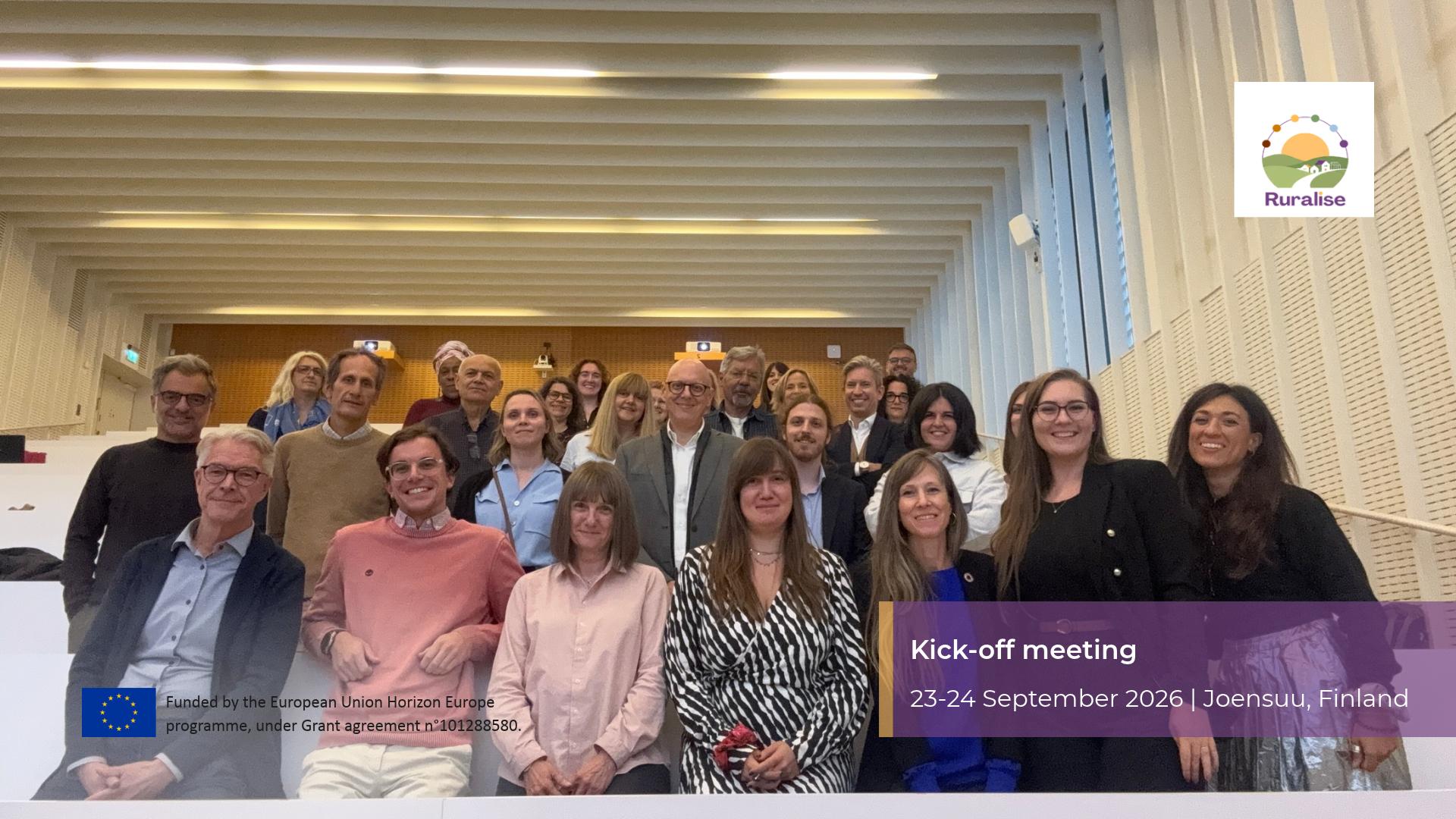
The Ruraliseconsortium met on 23-24 September in Joensuu, Finland, hosted by the University of Eastern Finland, for the project’s kick-off meeting. The meeting marked the beginning of a collaborative effort to better understand rural housing challenges and develop solutions that can respond to different local contexts across Europe.
During the kick-off meeting, partners discussed the project’s objectives, key activities and implementation approach, aligned on their shared vision and planned the next steps for the work ahead. The meeting also provided an opportunity to connect the different partners and perspectives that will contribute to Ruralise over the coming years.
The project will implement six pilot projects in Bulgaria, Finland, Greece, Ireland, Italy, and Norway, where local solutions will be explored and tested in collaboration with relevant stakeholders, with the main objective of strengthening rural housing affordability, accessibility, and resilience.
Alongside the pilot activities, Ruralise will develop the Ruralise Studio, an online platform combining a knowledge centre and decision-making environment. The Studio will bring together data, community insights and tested solutions to support local governments, housing providers, builders and residents in making informed decisions around rural housing.
The Technoeconomics of Energy Systems laboratory (TEESlab) will contribute to Ruralise across several interconnected areas of the project. The team will lead work to identify stakeholder data needs, existing gaps and barriers to accessing information needed for rural housing and regeneration planning, while also coordinating the collection and consolidation of data across the six pilot regions. This work will support the development of robust, locally grounded baseline datasets covering housing, buildings, affordability, demographic and social trends, sustainability and governance.
Building on this evidence, TEESlab will also lead the development of locally informed rural housing typologies, combining structural and spatial characteristics with demographic, economic, social and cultural factors and translating them into practical knowledge for the Ruralise Studio and its decision-making environment. Beyond the analytical work, the team will contribute to strengthening the uptake and transferability of Ruralise results through policy engagement, partnerships with relevant European and national initiatives, and the coordination of scientific dissemination activities.
The project’s work is aligned with major European initiatives, including the EU Rural Pact, the Renovation Wave and the Affordable Housing Initiative, contributing to wider efforts to strengthen the resilience and inclusiveness of rural communities.
With the project now officially underway, the consortium will move forward with its research, pilot activities and stakeholder engagement, working towards practical approaches that can help rural communities address housing challenges while making the most of their local strengths.