Despite a growing body of research seeking to integrate social sciences into scenario-based research and modelling, climate policy analysis remains largely dominated by top-down approaches that underrepresent the sociopolitical dimensions of the energy transition, particularly at the local level. In this context, the concept of energy citizenship has gained increasing attention as a means of fostering more inclusive, democratic, and equitable energy systems. However, significant gaps exist regarding its conceptual clarity, operationalisation, and systematic integration into scenario-based research and modelling practices.
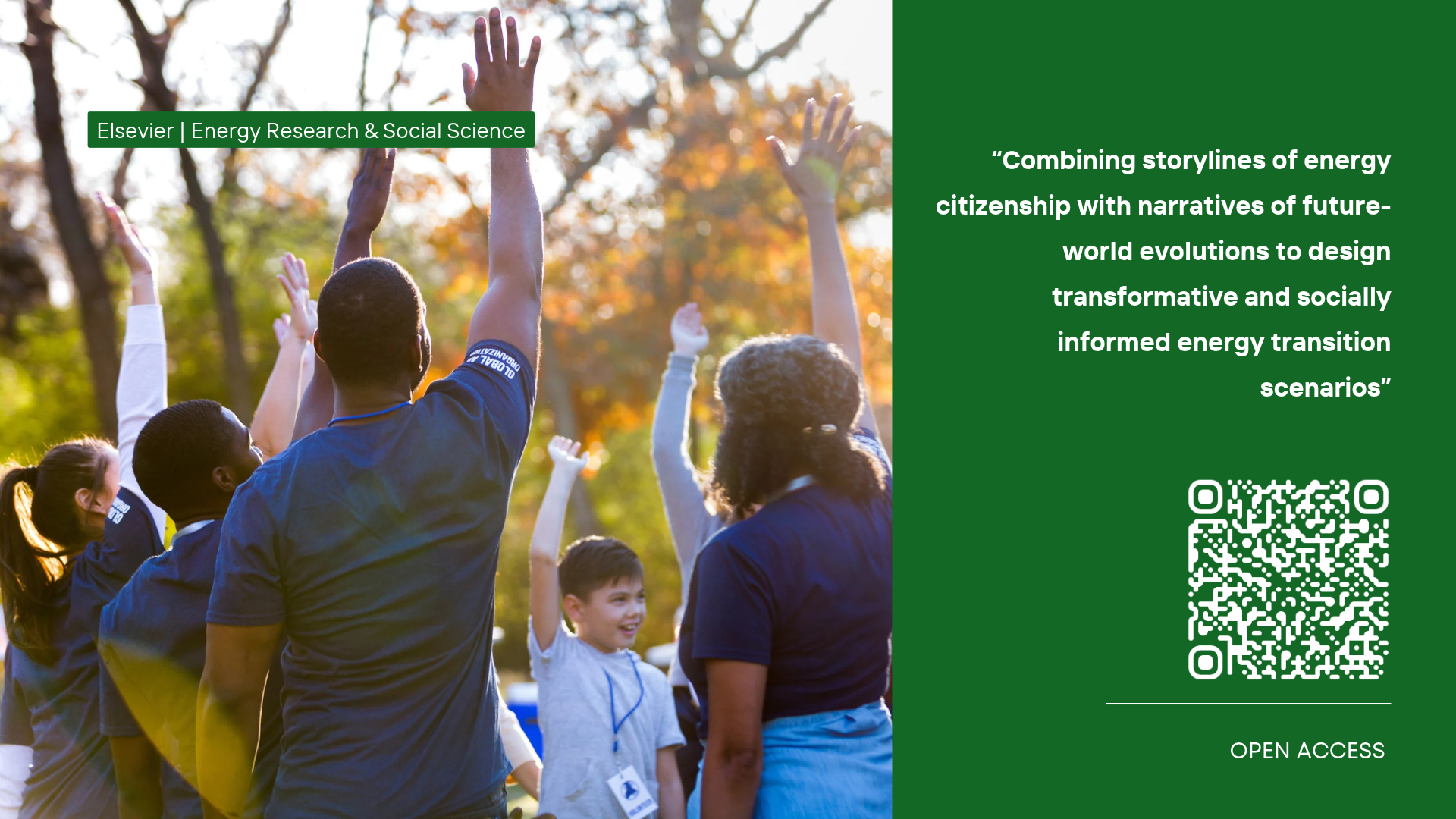
Our new open-access study “Combining storylines of energy citizenship with narratives of future-world evolutions to design transformative and socially informed energy transition scenarios”, published in Elsevier’s “Energy Research & Social Science” journal, addresses this gap by proposing an interdisciplinary framework that explicitly connects energy citizenship with alternative future-world evolutions.
In particular, we deconstruct energy citizenship into distinct patterns and trends and translate them into people–centred storylines that capture diverse forms of individual and collective engagement in the energy transition.
These storylines are embedded within three future–world narratives inspired by the Shared Socioeconomic Pathways (SSPs), while describing alternative long-term pathways in which citizen agency, social practices, and collective action play the central role. We construct a multilayered scenario space that enables systematic exploration of decarbonisation pathways informed by empirical research clarifying the concept of energy citizenship, while also testing the robustness of transition strategies under contrasting sociopolitical conditions.
Overall, the proposed framework advances understanding of how energy citizenship can shape energy transition pathways, while also providing less stylised and more transparent assumptions for scenario-based modelling. It also offers a platform for continued exchange between modelling communities, policymakers, and practitioners, supporting more inclusive climate action.
You can read the full open access paper here: https://www.sciencedirect.com/science/article/pii/S2214629626004974.