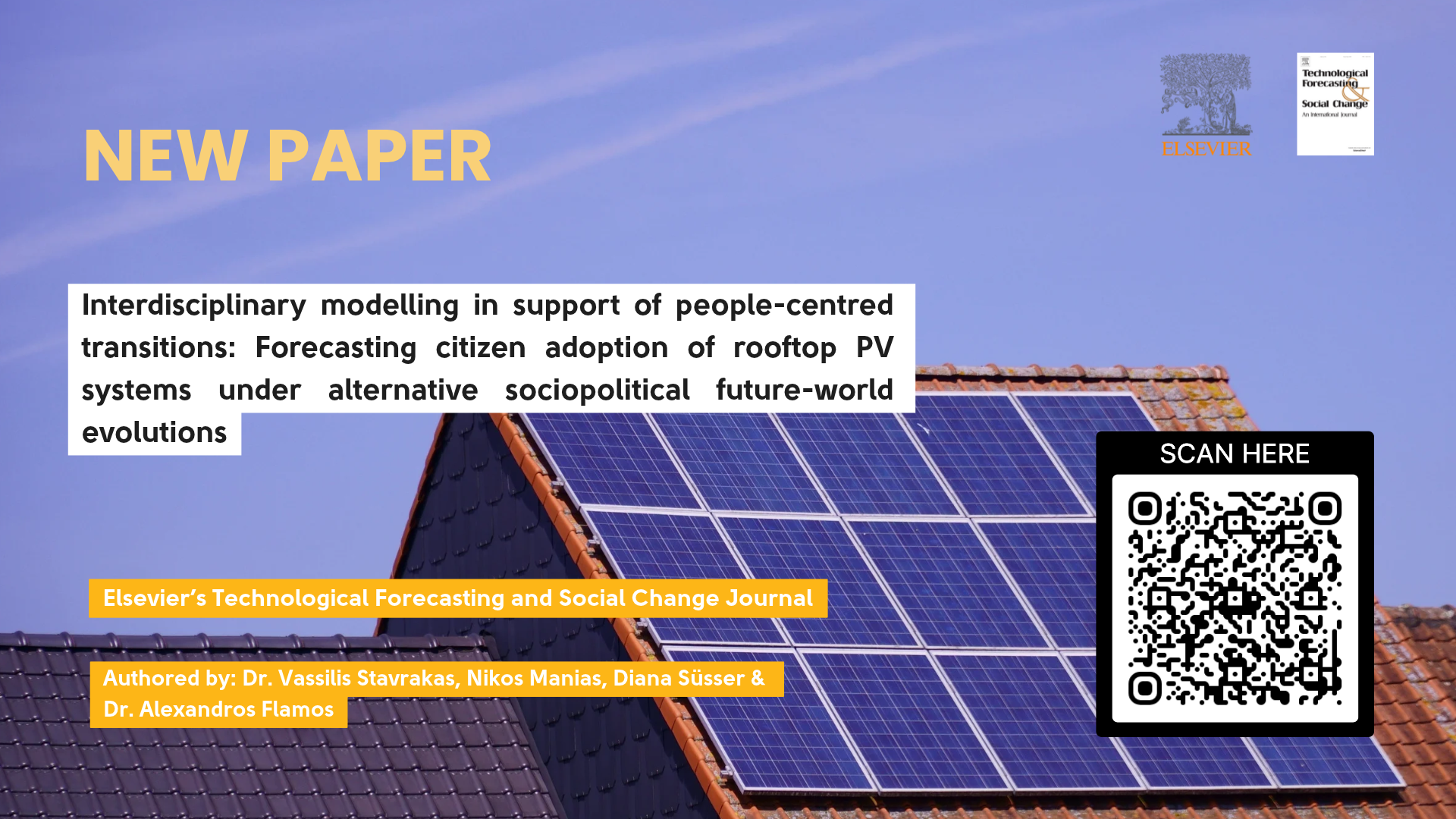
Our new scientific paper entitled “Interdisciplinary modelling in support of people–centred transitions: Forecasting citizen adoption of rooftop PV systems under alternative sociopolitical future–world evolutions”, published in Elsevier’s “Technological Forecasting and Social Change” journal explores how alternative sociopolitical futures and energy policy designs could shape the adoption of residential rooftop photovoltaic (PV) systems in Greece by 2030.
In particular, the aim of this article is to investigate citizen adoption of rooftop PV systems in the Greek residential sector by 2030 under three alternative sociopolitical storylines representing people–powered, government–directed, and market–driven future-world evolutions.
The study applies an interdisciplinary modelling framework that sequentially couples sociopolitical storyline development with agent-based technology adoption modelling. The framework is applied to assess the recently introduced net billing scheme in Greece, both as a standalone policy and in combination with battery energy storage system subsidisation, and to benchmark its performance against former feed-in tariff and net metering designs.
The results indicate that the former net metering scheme remains the most effective of the assessed policy designs by 2030, followed by net billing, which performs comparatively robustly when combined with energy storage subsidies. However, none of the schemes examined is sufficient on its own to achieve Greece’s national target of 1 GW of residential rooftop PV capacity by 2030.
The findings also highlight how adoption trajectories vary depending on citizens’ perceptions of profitability, trust in policy stability, social learning, and willingness to invest. These factors underline the importance of considering behavioural and sociopolitical uncertainty when designing policies to accelerate rooftop PV deployment.
By linking policy design with citizen behaviour and alternative future scenarios, the study contributes to the development of more adaptive and people-centred approaches to the energy transition.
Read the full paper here: https://www.sciencedirect.com/science/article/pii/S0040162526003793?via%3Dihub