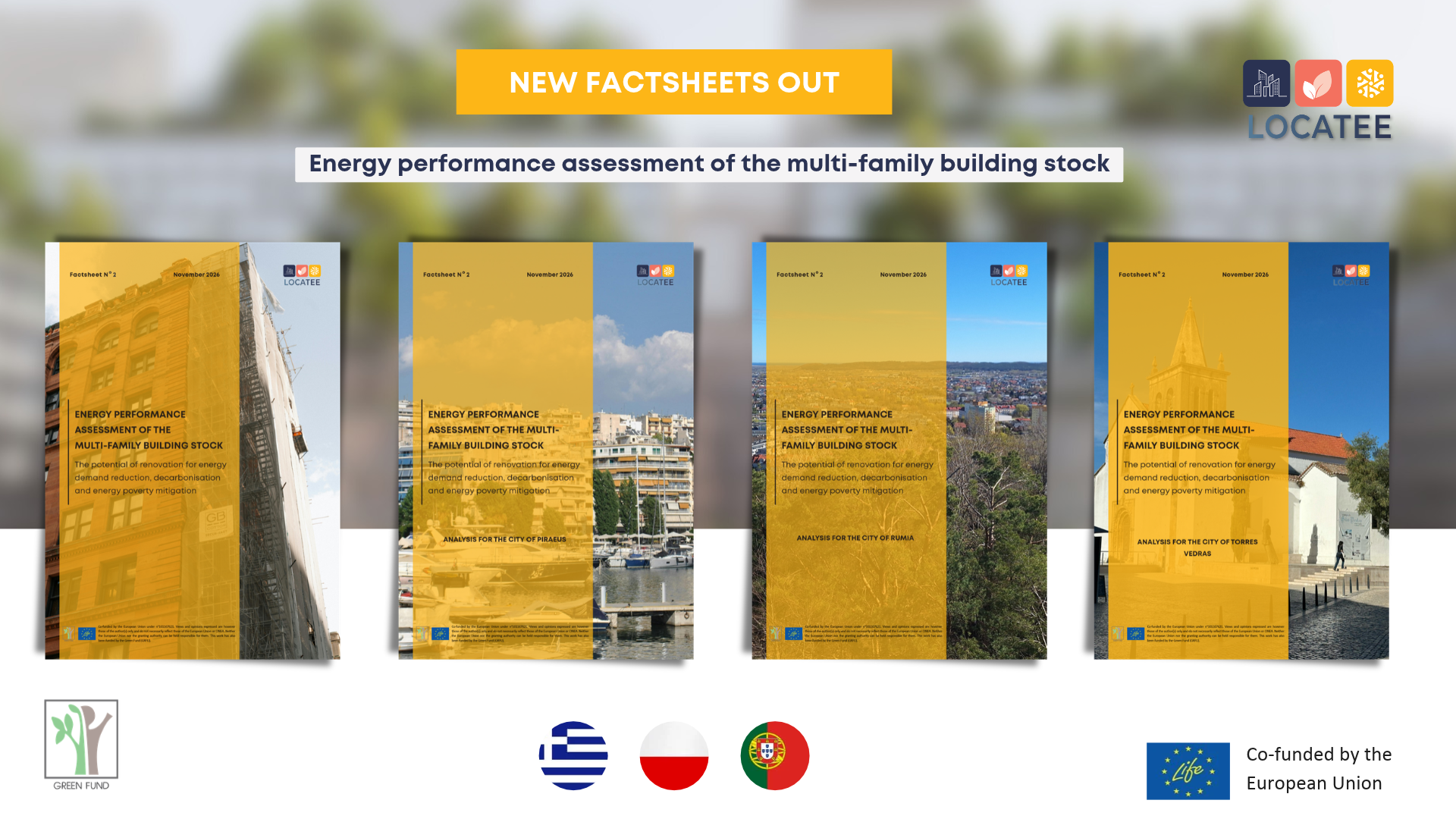
The LOCATEE project has released four new factsheets developed under Deliverable 3.3, “Energy performance assessment of the multifamily building stock: The potential of renovation for energy demand reduction, decarbonisation and energy poverty mitigation.” The factsheets highlight the potential of targeted energy renovation measures to reduce energy demand, lower household energy costs, support the decarbonisation of the residential sector and contribute to energy poverty mitigation.
The publication includes an overall assessment covering the three pilot municipalities, alongside three dedicated factsheets focusing on Piraeus (Greece), Rumia (Poland) and Torres Vedras (Portugal).
The analysis builds on 23 representative dwelling typologies, developed using local building stock data, including construction periods, energy performance classes and heating systems, to reflect the characteristics and renovation needs of each pilot municipality. Using the DREEM model, a dynamic, bottom-up energy simulation model developed by the Technoeconomics of Energy Systems laboratory (TEESlab), the assessment examines household energy demand and evaluates the potential impact of different renovation measures.
The scenarios include energy efficiency interventions such as building insulation and windows replacement, heating system upgrades, heat pump installations and solar photovoltaic systems. Their impacts are compared in terms of energy savings, carbon emissions reduction, investment cost-effectiveness and potential household energy bill reductions.
The findings highlight the significant potential of heat pumps to reduce energy consumption and household energy costs, while demonstrating how the effectiveness of different interventions depends on the characteristics of existing dwellings and local conditions.
By combining these technical findings with LOCATEE’s energy poverty vulnerability mapping, the results can support municipalities in identifying priority interventions, designing more targeted renovation strategies and allocating available resources more effectively, particularly to support energy-vulnerable households.
Explore the four LOCATEE factsheets: