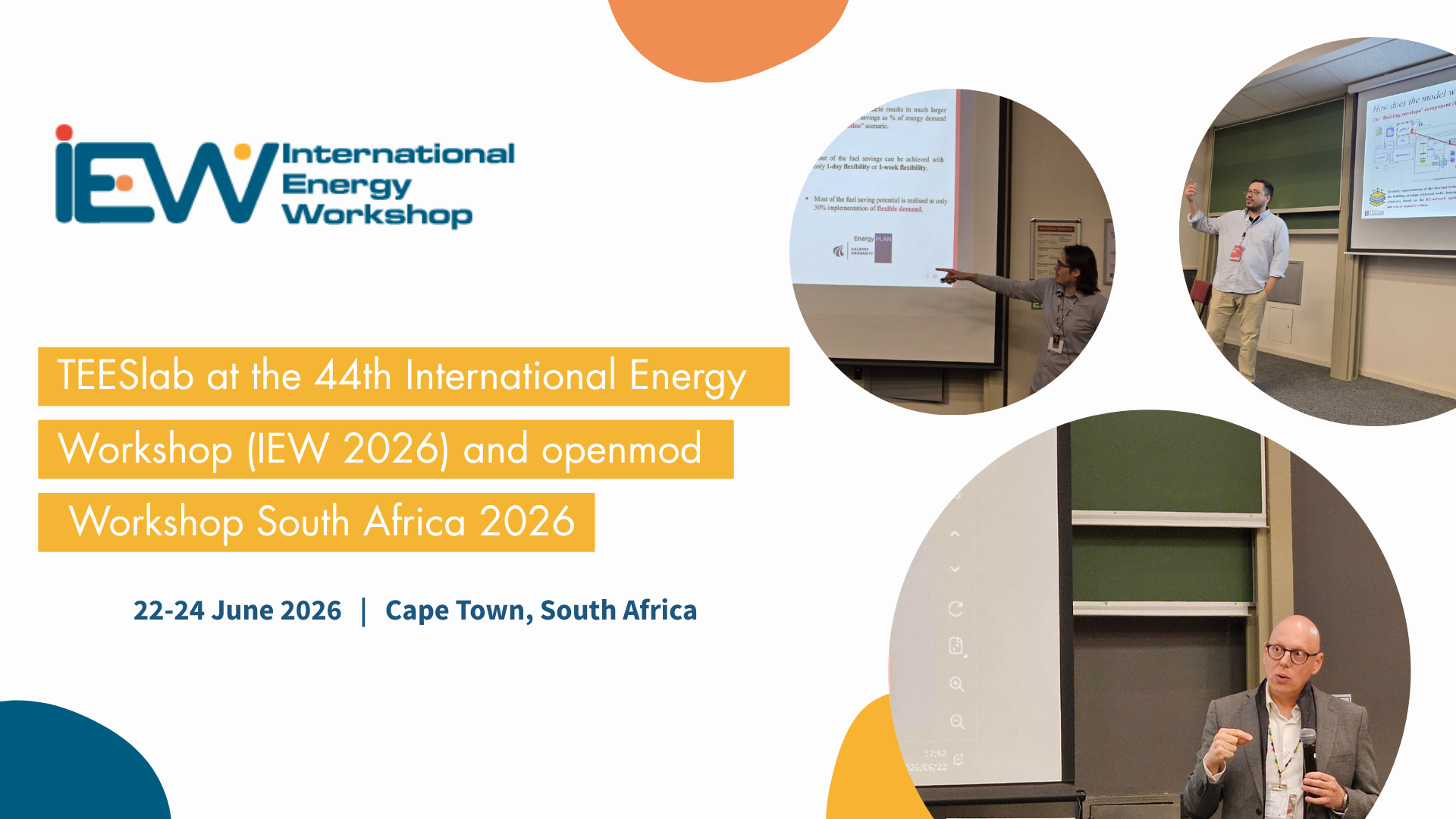
The Technoeconomics of Energy Systems Laboratory (TEESlab) participated in the 44th International Energy Workshop (IEW 2026), held at the University of Cape Town, South Africa, on 22-24 June 2026. Our laboratory also contributed to the openmod Workshop South Africa 2026, organised by the Energy Systems Research Group at the University of Cape Town.
Through three presentations, TEESlab showcased its research on energy systems modelling, covering topics related to energy justice, demand-side modelling, building flexibility, and decarbonisation pathways.
Dr. Alexandros Flamos presented the work entitled “Income inequality and energy transition in the power sector: Bottom-up modelling analysis based on transformative scenario design” during the Energy Justice and Equity session of IEW 2026. The study was developed within the framework of the Horizon Europe “IAM COMPACT” project.
The study combined the OSeMOSYS-GR model, the DREEM (Dynamic high-Resolution dEmand-sidE Management) model, and a dedicated distributional impact assessment framework to examine the long-term socioeconomic implications of alternative electricity system configurations. The results demonstrated that more decentralised electricity systems can improve household affordability, reduce income inequalities, and distribute the benefits of the energy transition more equitably, while enhancing system resilience through distributed energy resources and demand-side flexibility.
Dr. Vassilis Stavrakas presented our in-house DREEM (Dynamic high-Resolution dEmand-sidE Management) model at both IEW 2026 and the openmod Workshop South Africa 2026.
The presentation focused on the role of the buildings sector in the energy transition- and particularly on how high-resolution, bottom-up demand-side modelling can help us better understand the contribution of buildings to energy efficiency, electrification, demand-side flexibility, and decarbonisation pathways.
Nikos Kleanthis presented the work entitled “Top-down and bottom-up modelling of current and future decarbonisation trends in the buildings sector at the global and the European Union levels”, developed within the framework of the Horizon Europe “IAM COMPACT” project.
Our participation in IEW 2026 and the openmod Workshop South Africa 2026 reflects the laboratory’s commitment to developing open, transparent, and policy-relevant energy modelling tools that support evidence-based decision-making towards decarbonisation, energy efficiency, and energy justice.
The events provided valuable opportunities to exchange ideas with the international energy modelling community, strengthen existing collaborations, and establish new partnerships for future research initiatives.
To learn more about TEESlab’s research and modelling tools, explore our modelling suite here.