
-
Test
New research paper published: Paving the way to carbon neutrality in the Greek power sector!
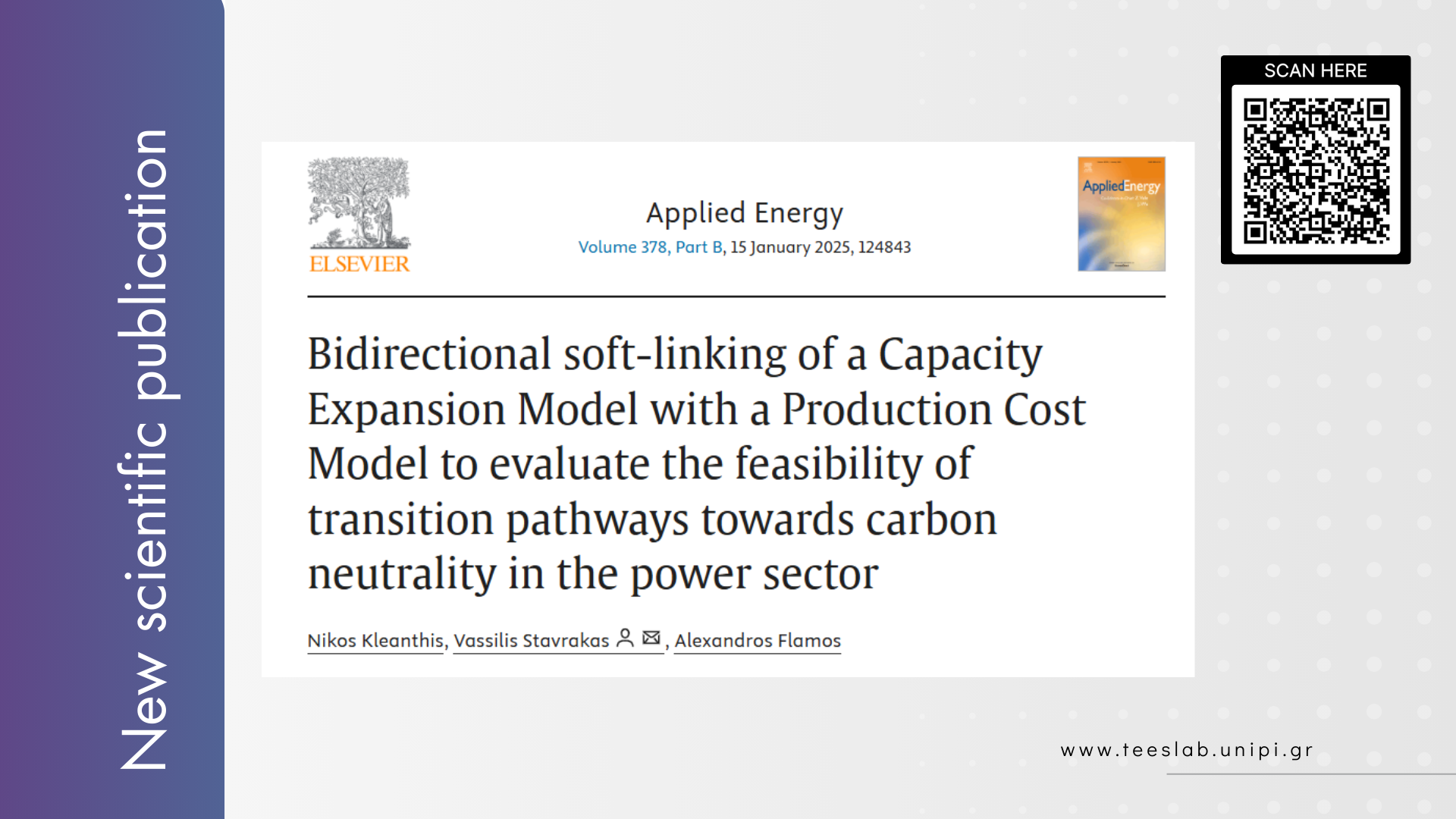
Our team has recently published our new scientific publication entitled “Bidirectional soft-linking of a Capacity Expansion Model with a Production Cost Model to evaluate the feasibility of transition pathways towards carbon neutrality in the power sector” at Elsevier’s Applied Energy Journal. This paper is co-authored by Nikos Kleanthis, Dr. Vassilis Stavrakas, and Prof. Dr. Alexandros Flamos, and is produced within the context of the EC-funded projects, IAM COMPACT and ENCLUDE. This article introduces a novel bidirectional soft-linking approach between two open-source energy models to generate long-term scenarios in the power sector and evaluate their feasibility, allowing for the optimisation of…

-
Test
From vision to action: LOCATEE kick-off highlights!
The new LOCATEE project, funded by the European Commission’s LIFE Programme, has officially kicked-off! With an ambitious and dedicated team, we’re set to bring innovative solutions to local municipalities in tackling energy poverty! LOCATEE aims to support local municipalities in tackling energy poverty by facilitating the renovation of private multi-apartment buildings for vulnerable residents. The project will provide a comprehensive toolkit to identify energy vulnerable households, match tailored interventions to their needs, and incorporate energy poverty alleviation activities into the long-term strategic frameworks of municipalities, such as Sustainable Energy & Climate Action Plans (SECAPs). LOCATEE’s approach will be implemented in…
-
Test
PROSPECT+ Capacity Building Programme: 3rd call for mentees is now open!
The Horizon 2020 PROSPECT+ project announces the 3rd learning cycle for cities, regions and local energy agencies to participate as mentees at the Capacity Building Programme (CBP). The Capacity Building Programme (CBP) offers mentoring and training on innovative financing schemes in five different areas: i. public buildings, ii. private buildings, iii. public lighting, iv. transport, and v. cross-sectoral. Attention is given to improving the decision-making of cities and regions on how to choose projects for financing, as well as how to assess and ensure that the projects are finance ready. Applicants will have the opportunity to work side by side…
-
Test
TIPPING+: Field visit at Megalopolis’ energy center!
The Technoeconomics of Energy Systems laboratory (TEESlab), within the context of the Horizon 2020 TIPPING+ project, participated in a two-day trip at the Coal and Carbon Intensive Region of Megalopolis and the nearby capital of the regional unit, Tripoli. During the two-day visit, we visited the natural gas and lignite units located in Megalopolis. We were able to meet with local stakeholders from the PPC S.A. and the Municipality of Megalopolis to discuss the economic and social aspects of decarbonization. We talked about the future of investments in the region aiming to increase local employment as well as critical challenges…
-
Test
ENPOR Newsletter: 5th edition is here!
The Horizon 2020 ENPOR project published its 5th Newsletter, focusing on the project’s latest news and events.. This issue presents our scientific publication entitled “How to improve energy efficiency policies to address energy poverty? Literature and stakeholder insights for private rented housing in Europe” published at Elsevier’s Energy Research & Social Science journal and written by Dimitris Papantonis, Dimitra Tzani, Manon Burbidge, Dr. Vassilis Stavrakas, Stefan Bouzarovski, and Professor Dr. Alexandros Flamos, within the context of the project. The paper identifies structural factors that serve as barriers to, and solutions for, the implementation of energy efficiency policies in the private…
-
Test
The SENTINEL project came to an end!
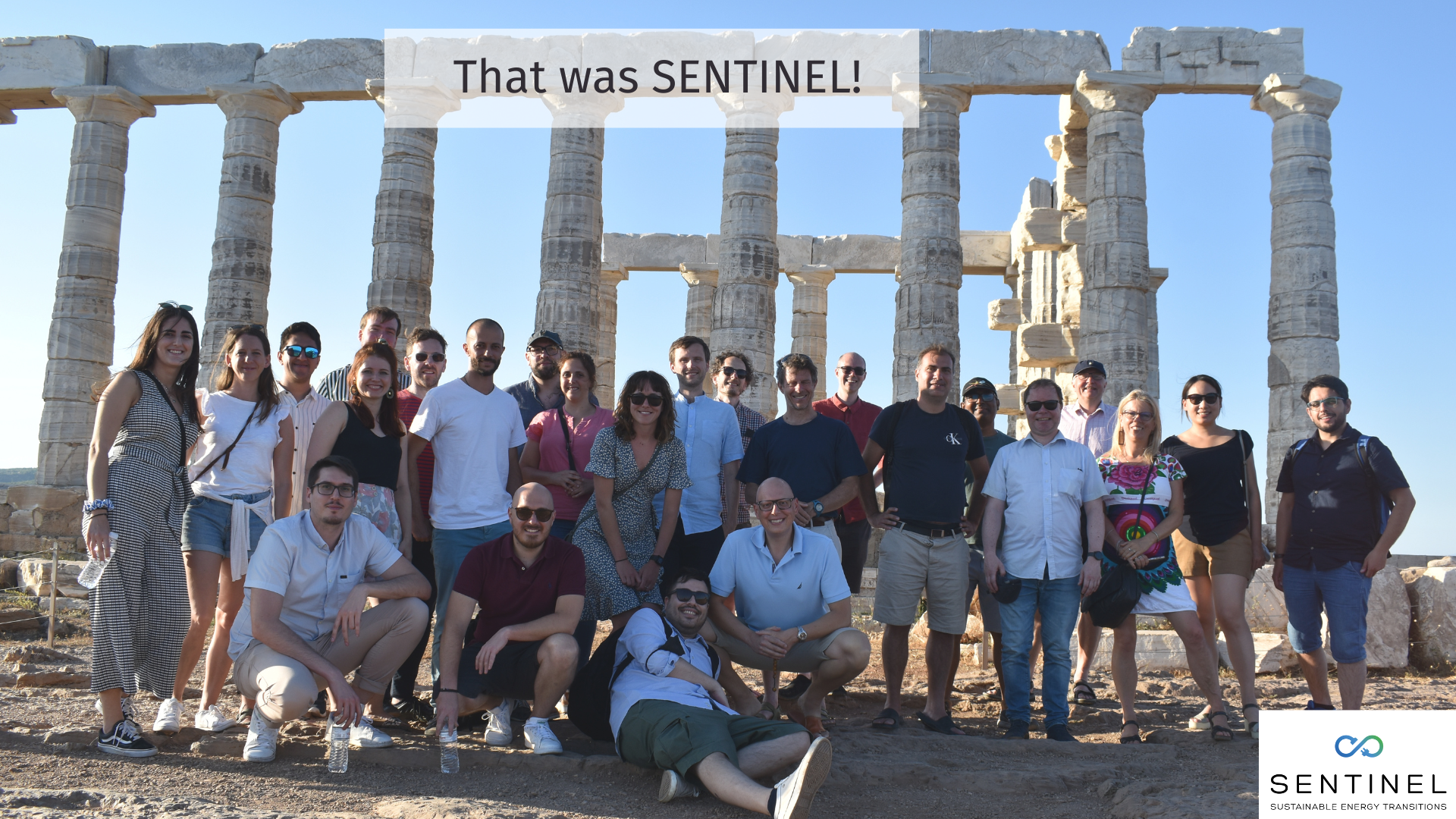
After 3.5 years of an amazing collaboration between 13 partners from 9 European counties the Sustainable Energy Transition Laboratory (SENTINEL) project has been completed! The aim of the project was to create a new modelling framework, modular in structure, incorporating many separate models, which will look in detail at specific technological, geographic, and societal aspects of the transition to a low-carbon energy system. To this end, SENTINEL included a set of case studies at three different geographical levels: 1. National (Greece), 2. Regional (Nordic countries), and 3. Continental (European Union, Norway, Switzerland, the United Kingdom, and some Balkan countries), to…
-
Test
ENCLUDE Newsletter #3: Christmas edition is here!
The Horizon 2020 project Energy Citizens for Inclusive Decarbonization (ENCLUDE) project issued the 3rd Newsletter, focusing on the latest news and events of the project and providing an update on the initial survey results on Collective Energy Initiatives. In this Issue, you will learn about: Results on the manifestation of energy citizenship after analysing 68 European Collective Energy Initiatives (CEIs). The focus of the Booklet is on investigating how CEIs take into account topics such as energy poverty, conflict resolution, information sharing, decision making processes, and how they interact with the local community. How you can contribute to advancing the…
-
Test
ENCLUDE: 2nd Newsletter is now released!
The Horizon 2020 project Energy Citizens for Inclusive Decarbonization (ENCLUDE) project issued the 2nd Newsletter, focusing on the first sessions of our Academy for Energy Citizenship Leadership and the exciting events that ENCLUDE has participated in. Key takeways: ENCLUDE Academy: In particular, the Newsletter provides information about the ENCLUDE Academy for Energy Citizen Leadership, an online program for leadership development and civic engagement for decarbonization and its benefits to the participants regarding the reduction of carbon emissions to their own communities. The ENCLUDE Academy’s opening session took place in September 2022 focusing on providing answers to interesting and insightful questions…
-
Test
SENTINEL final event: How can the European Union achieve climate-neutrality by 2050?
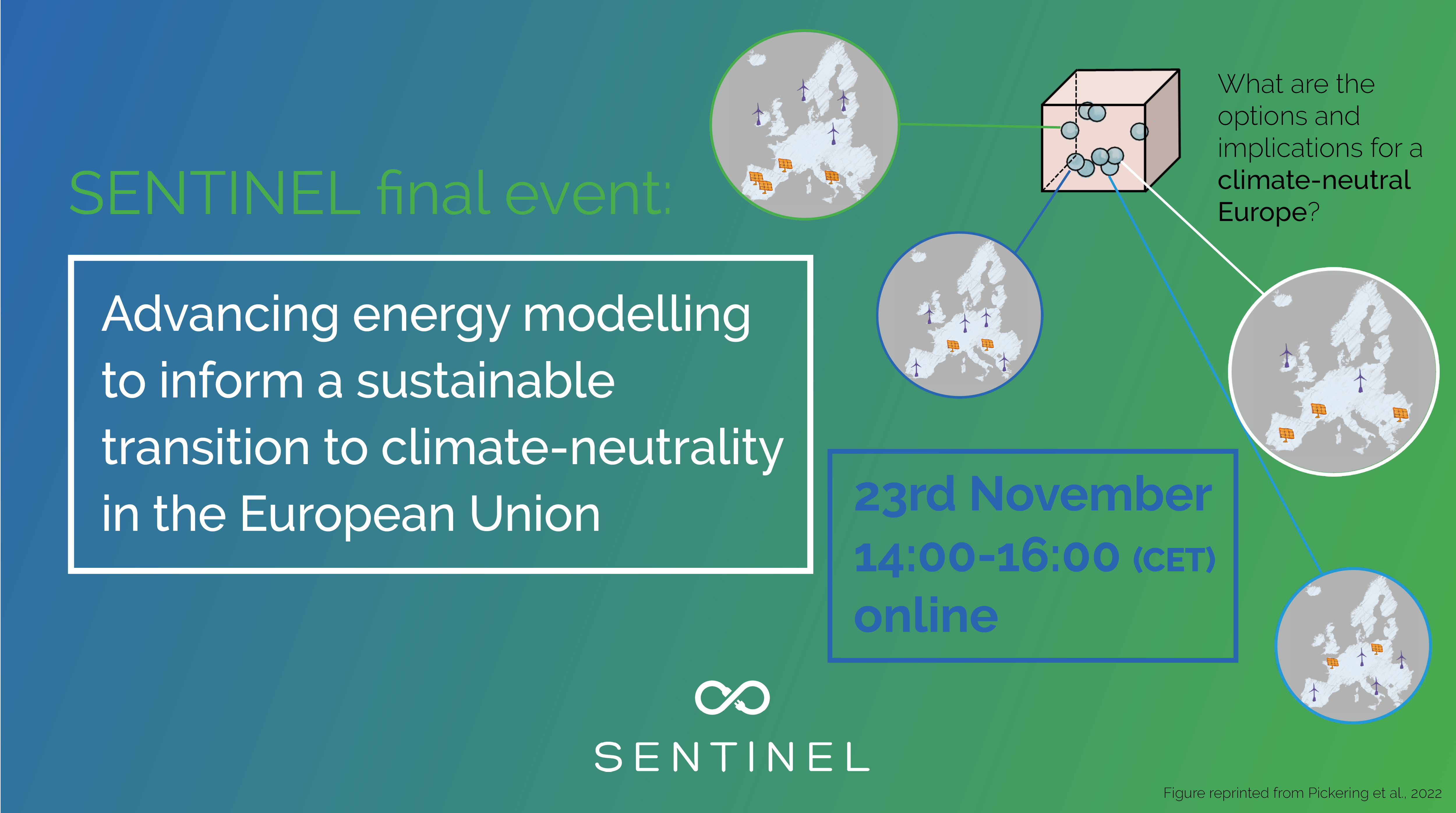
The Technoeconomics Energy Systems laboratory (TEESlab), in collaboration with the Institute for Advanced Sustainability Studies, the Renewables Grid Initiative, the Delft University of Technology, and the Autonomous University of Barcelona, are organising the SENTINEL final event, entitled “Advancing energy modelling to inform a sustainable transition to climate-neutrality in the European Union”. The aim of the event is to present the key findings of the project and the implications about the transition to carbon neutrality by 2050 in the European Union. Date: Wednesday, November 23 2022 Time: 14:00-16:00 CET Link to register here! Over the past 3.5 years, the Sustainable Energy…
-
Test
New SENTINEL Stakeholder Workshop Synthesis Report
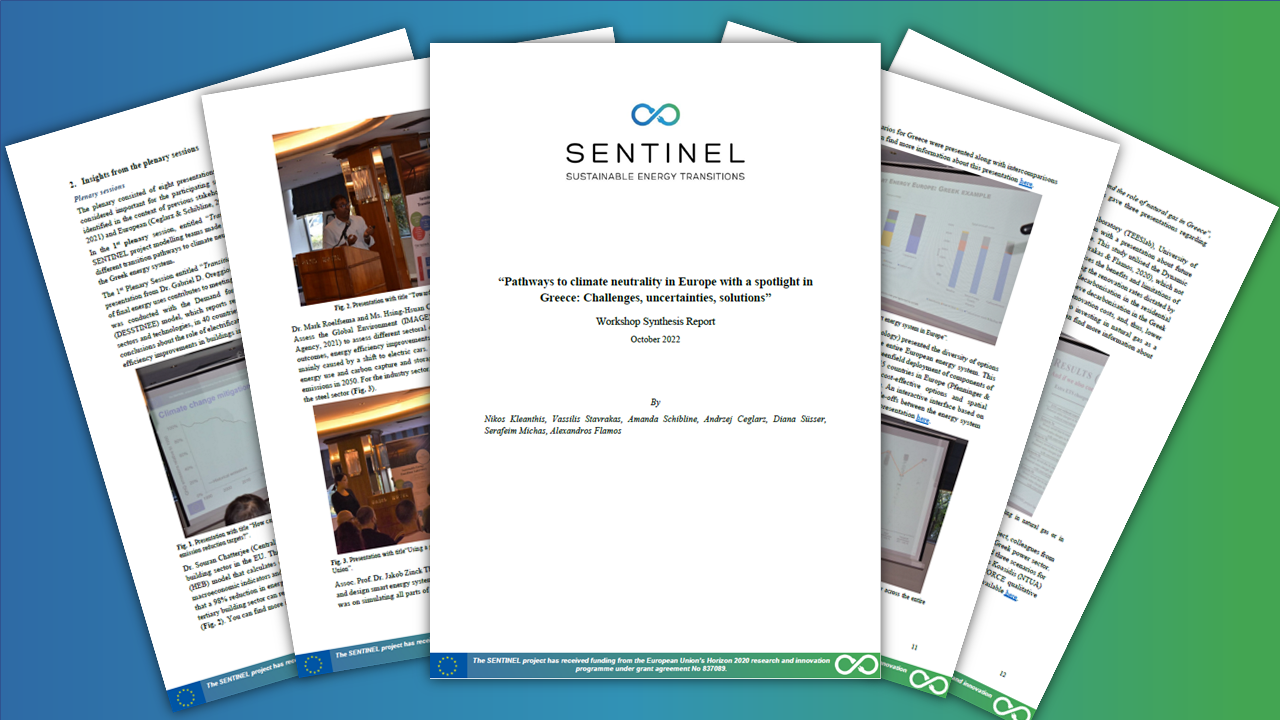
In June 2022, the Technoeconomics of Energy Systems laboratory (TEESlab) and the Decision Support Systems Laboratory (DSS Lab), in collaboration with the Public Power Company (PPC), co-organised a stakeholder workshop entitled “Pathways to climate neutrality in Europe with a spotlight in Greece: Challenges, uncertainties, solutions”. The workshop took place within the context of the European Commission (EC)-funded H2020 funded projects SENTINEL and PARIS REINFORCE. A dedicated synthesis report providing a summary about the stakeholder workshop has been produced by Nikos Kleanthis, Dr. Vassilis Stavrakas, Amanda Schibline, Andrzej Ceglarz, Diana Süsser, Serafeim Michas and Professor Dr. Alexandros Flamos and is now…
-
Test
SENTINEL Open Access paper: Stakeholders’ perceptions on the critical issues of the transition to climate neutrality
Our new paper entitled “Eliciting knowledge from stakeholders to identify critical issues of the transition to climate neutrality in Greece, the Nordic Region, and the European Union” is now published at Elsevier’s Energy Research & Social Science journal! The article is produced by Nikos Kleanthis, Dr. Vassilis Stavrakas, Andrzej Ceglarz, Diana Süsser, Amanda Schibline, Johan Lilliestam and Professor Dr. Alexandros Flamos within the context of the European Commission (EC)-funded H2020 Sustainable Energy Transitions Laboratory (SENTINEL) project. There are considerable differences in the pace and underlying motivations of the energy transition in the different geographical contexts across Europe. The European Union’s…
-
Test
New SENTINEL publication: Why energy models should integrate social and environmental factors?
Our new scientific paper entitled “Why energy models should integrate social and environmental factors: Assessing user needs, omission impacts, and real-word accuracy in the European Union” has been published at Elsevier’s Energy Research & Social Science journal! The publication is produced by Professor Dr. Alexandros Flamos, Diana Süsser, Nick Martin, Dr. Vassilis Stavrakas, Hannes Gaschnig, Laura Talens Peiró, Cristina Madrid-Lopez and Johan Lilliestam, within the context of the European Commission-funded Horizon 2020 SENTINEL project. The aim of the paper is to explore and illustrate the impact of ignoring such factors by comparing model results to model user needs and real-world…