
-
Test
ENCLUDE: The 3rd General Assembly was completed!
The TEESlab – Technoeconomics of Energy Systems laboratory participated in the 3rd General Assembly of the ENCLUDE project that took place on February 2, 2023 in Brussels. During the meeting, ENCLUDE partners gathered together to discuss the project’s progress over the past 18 months and to explore and plan the next steps concerning the ENCLUDE Academy and the Interactive Policy Platform. For this General Assembly the main goal was to prepare for the project’s first review meeting with the European Commission. In particular, Dr. Vassilis Stavrakas presented the workplan and achievements of Work Package 5 (WP5). Our team is responsible…

-
Test
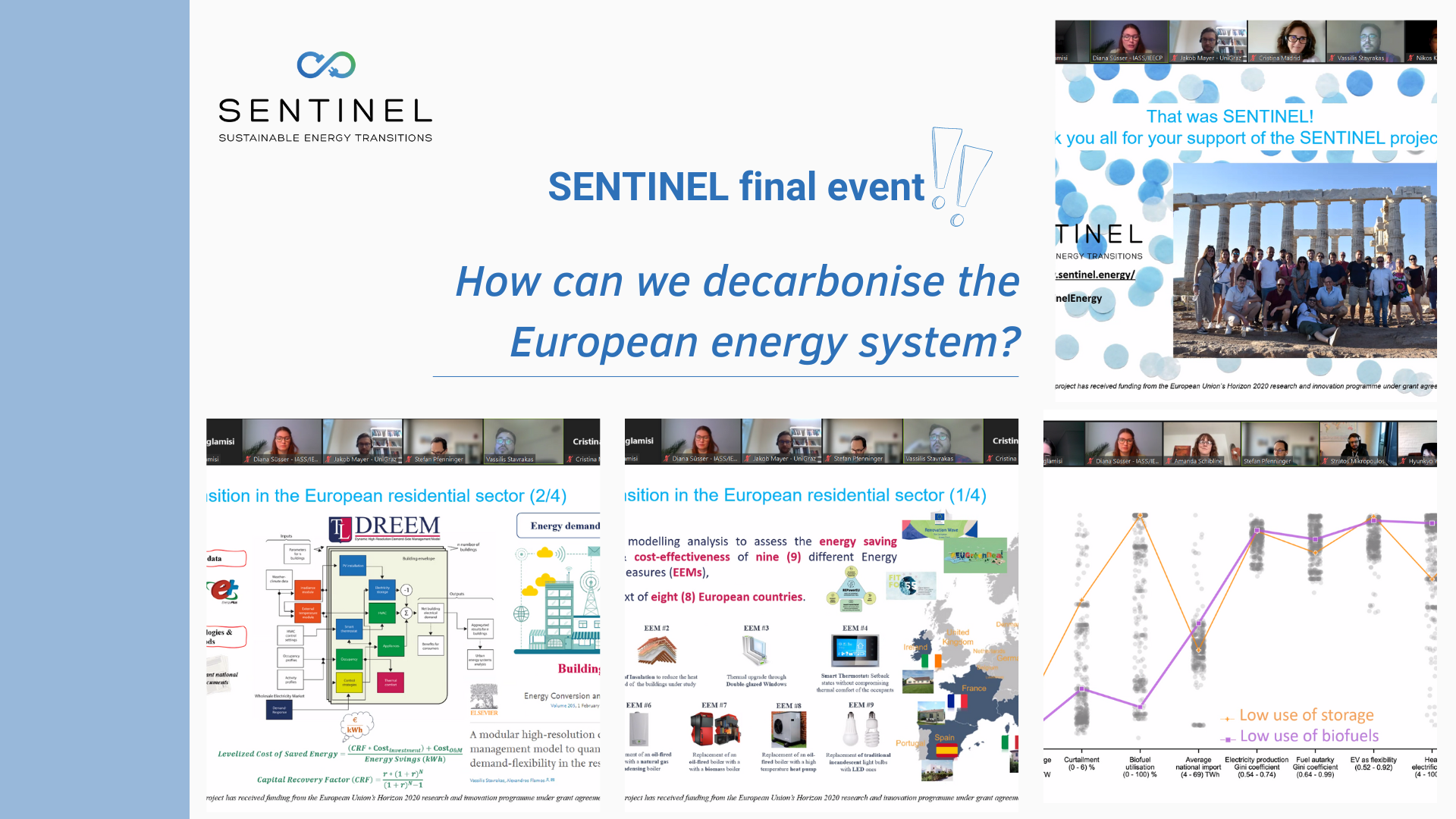
SENTINEL final event: How can we decarbonise the European energy system?
The final online event of the SENTINEL, project which took place on the 23rd of November 2022, was a great success, gathering not only stakeholders participating in previous SENTINEL events but also newcomers. The aim of the event was to present and discuss key insights about the options for a transition to climate neutrality in the Europe as well as its multiple implications. More than 60 participants, mainly representing the research community joined our final event. The workshop consisted of plenary participation, divided into two sessions: i. a presentation of the project, its stakeholder engagement process, and modelling results and…
-
Test
Welcome to our new Horizon Europe project “IAM COMPACT”!
IAM COMPACT , our new project funded under the European Union’s Horizon Europe Research and innovation funding programme has officially kicked-off! Vision & aim: The project’s vision is to expand the modelling comfort zone to account for deep uncertainties and disruptive events or innovations. To do so, IAM COMPACT aims to support the assessment of global climate goals, progress, and feasibility space, as well as the design of the next round of Nationally Determined Contributions (NDCs) and policy planning beyond 2030 in EU, major emitters, and non-high-income countries, through integrating a diverse ensemble of national and global Integrated Assessment Models…
-
Test
Model-based policymaking or policy-based modelling? How energy models and energy policy interact
Mr. Vassilis Stavrakas, Senior Research Associate at the Technoeconomics of Energy Systems laboratory(TEESlab) participated at this year’s Energy Modelling Platform for Europe (EMP-E) Conference (EMP-E 2021) and the Special Session ‘Making Energy Models more relevant for Policymaking’, to present along with SENTINEL colleagues from the Institute for Advanced Sustainability Studies (IASS) and the Renewables Grid Initiative (RGI) their scientific paper “Model-based policymaking or policy-based modelling? How energy models and energy policy interact”, shedding light on the factors that foster or hinder the use of energy system models in policymaking processes. The key takeaways from the session are ?: ▹ Models…
-
Test
Do energy models become better suited or just more complex?
We are glad to inform you that our scientific article “Better suited or just more complex? On the fit between user needs and modeller-driven improvements of energy system models” has been published in the Elsevier’s “Energy” peer-reviewed journal. Energy system models are advancing rapidly. However, it is not clear whether models are becoming better, in the sense that they address the questions that decision-makers need to be answered to make well-informed decisions.In particular we show that: ? Model improvements and user needs align to large extends but there are differences. ? There is a common need for a better representation…
-
Test
Model-based policymaking or policy-based modelling?
We are glad to inform you that our scientific article “Model-based policymaking or policy-based modelling? How energy models and energy policy interact” has been published in the Elsevier’s “Energy Research and Social Science” peer-reviewed journal. As energy models become more and more powerful, they are increasingly used to support energy policymaking. Although modelling has been used for policy advice for many years, there is little knowledge about how computer-based models actually influence policymaking, and to what extent policymakers influence the modelling process. In our article we empirically investigate (i). whether, how and when models influence the policy-making process, and (ii).…